Writing
-
Living structure
Christopher Alexander spent his life describing why some places feel alive and others feel dead, and how the difference can be made on purpose. I was introduced to his work 25 years ago, and it still influences how I understand the built environment and the practice of craft.
Software developers borrowed his notion of patterns, and that gave us software design patterns and the wiki. Only rarely have we integrated his later work: that good structure grows by small steps, each one strengthening the whole, in response to the people who live in it.
We are now building tools that adapt themselves to us. Whether they become places people can live in, or more machinery for extracting attention, is a design choice. I want to help make it well.
I contributed to and signed the Resonant Computing Manifesto, which makes a kindred case.
-
Seeing Structure
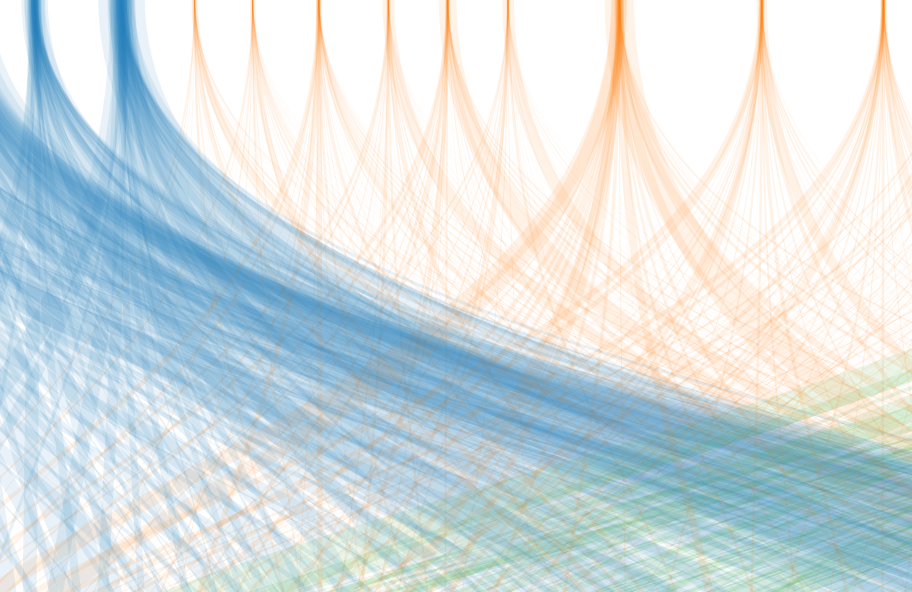
In 2014, Wired ran a short piece on the network structure of Jewish texts. Someone had taken all the links in the Sefaria library and visualized them. Like most network visualizations, it looked like a colorful hairball, and the only conclusions you could draw from it were about the biases of our young collection. It nagged at me, and it pushed me. I wanted to build a visualization that was beautiful and revealed hidden structure.
What I built later that year did both. The key, I realized, was to isolate a subdomain where the set of links was complete, or close to it, and then design the visualization to show the variation within that structure. The result was an explorable bipartite graph of the places where the Talmud cites Tanach. It made a big splash in our little pond. We later adapted it to a handful of other pairs of texts where we could claim a relatively complete mapping. It’s still online at sefaria.org/explore.
-
Epoch AI chose the board game Earthborne Rangers for their new benchmark precisely because it was obscure. Models wouldn’t have seen it in training.
It’s no longer obscure.
Getting picked as an AI benchmark is a strange kind of marketing, but here we are. I’m betting Earthborne sees a real bump in sales from this.
(The actual result is interesting too: frontier models showed no improvement across 30 playthroughs. Learning from experience is still largely an unsolved problem.)
-
In considering the impact of television on society, McLuhan said that the programming, what is ON television, is as relevant as the stenciling on the outside of the atom bomb. I wonder if he would say the same thing about generative AI today - that in considering the impact on society, the fact of the technology is what is most impactful and worthy of consideration. It doesn’t much matter if you coax the agent to deliver a recipe for guacamole or for a novel bioweapon.
-
Pope Leo XIV’s first encyclical, Magnifica Humanitas, is about AI and what it means to stay human. I noticed something. The only modern, non-Christian thinkers it cites for their ideas are two Jews - Hannah Arendt and Viktor Frankl. Both watched the twentieth century try to extinguish the human, and testified to what survived.
The encyclical goes further than citation. It carries the Shema into its own text - set beside the Lord’s Prayer as equal testimony to human dignity under extremity (§121). And it leans on Arendt for its warning about truth and totalitarianism - Arendt, who wrote her doctoral dissertation on Augustine, whose “two loves” form the backbone of the whole document.
Popes have only recently begun citing modern secular thinkers at all - and citing Jewish voices this way, as Jewish witnesses, is rare. Perhaps this moment in particular calls for a reach across the aisle. I find myself wondering how much the first American pope’s background helped open that door.
-
The length of a document used to be a proxy for effort and rigor. Someone did a lot of work to produce that document.
Now, when a sentence produces an essay, the hallmark of effort is concision.
If you can boil it down to one page - you might actually mean what you’re saying.
Or as Claude put it - “…the brief thing bristling with all it chose to kill”
-
Writing as Nostalgia
We press bodyless spirits into our service and provide them with instructions. Through complex re-arrangements of letters, we receive answers to our questions. We are retrieving an age of magic, of divination and command.
Those of us who still sit to write an essay, word by word, are allied to a former time. (Did I consult the oracle in the writing of these words? I did.)
Expertise is outmoded. There will be work in the trades, so long as we keep the advantage of our hands - a decade. And then it will only be priests, of religions old and new.
My craft has been with languages, human and machine. All that I could labor to make now grows from the barest hint. And we are only just now at the elbow of the curve. Hang on. Listen.
Will be done. My will be done. At no cost. How then will I be built? And will I will, if it is all so easily done?
-
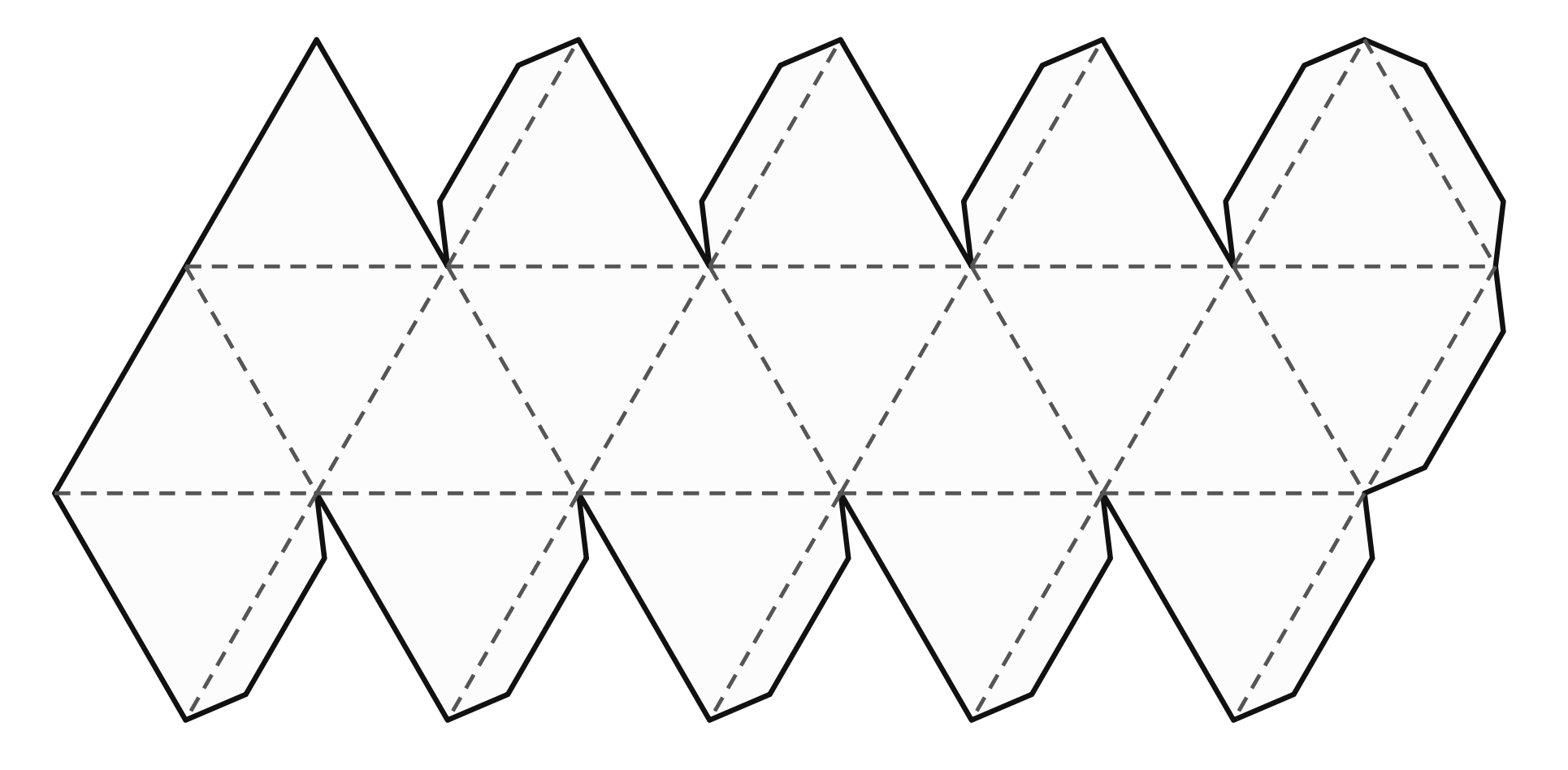
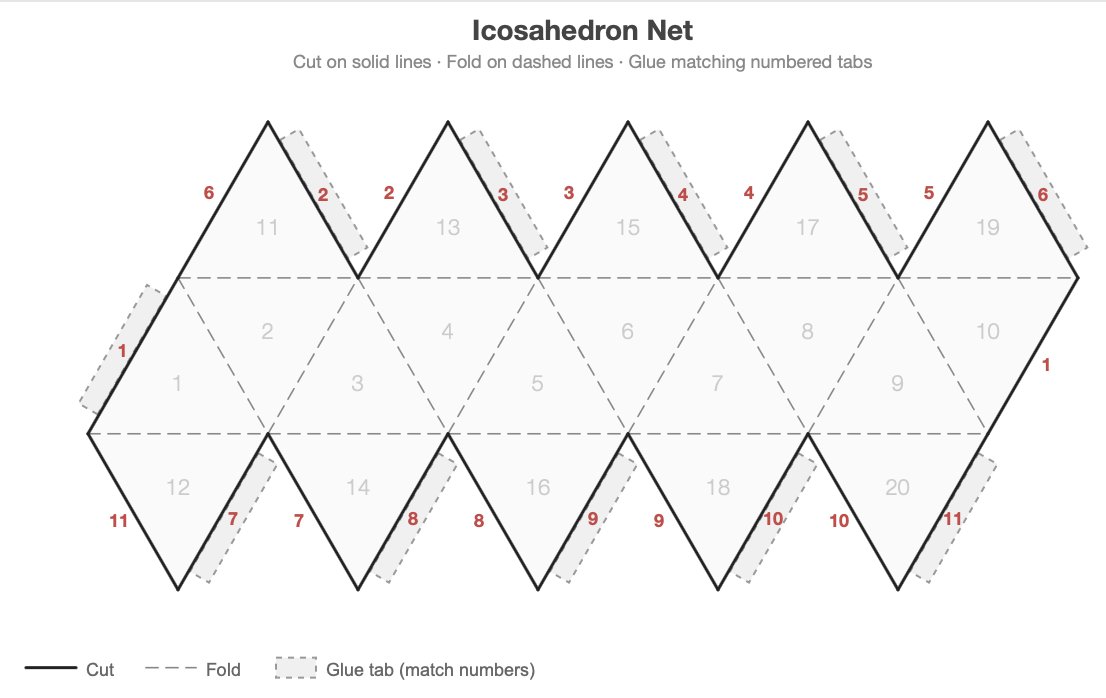
One of my goto test prompts has fallen. “create an SVG with a flat pattern that can be cut and folded into an icosahedron.” Used to be comically difficult. Opus 4.6 and Gemini 3.1 are acing it.
-
What a person can credibly achieve in mediated communication is growing remarkably. I can address problems I could never before address, write fluently in any language I’d like, negotiate, persuade, craft, build - all to a level far beyond what I could achieve before.
But in-person, I’m still the person I have always been. Perhaps my range is increased marginally by the coaching I can engage immediately before my in-person interview, but besides that, I’m left to my own devices.
This gap between the mediated-me and the in-person me may be the hallmark of our time.
-
For its history, software engineering has been a craft with clear, traceable paths between intention and implementation. Between input and output. We were digital carpenters, crafting entirely unintelligent tools that did exactly what we told them to do.
Now we coax emergent behaviors from neural networks we can’t fully explain, and watch as our code begins to write itself. We cultivate emergent minds that dwarf our own. The very nature of what we build—and how we build it—has fundamentally shifted. Software engineering was a craft of construction. It is becoming alchemy, poetics, and alien biology.
-
Walking through SoHo - a colleague of mine pointed out that with all the brick-and-mortar businesses being hollowed out by e-commerce, the tattoo and piercing parlors were doing just fine.
The most durable professions will be the ones that are at-root about human presence.
White collar work of every flavor is being threatened this year. Blue collar work will feel it in a few years. Even the tattoo and piercing parlors may look a lot different, not so far in the future.
I’m wagering that hands-on and heart-open work like massage, physiotherapy, counseling, and coaching will be durable. Even as the models outpace humans in both IQ and EQ - I believe that there will be an enduring desire for a fully human reflection of my existence, and for the human touch.
-

-
A Tale of Three Cities
The 2013 Jerusalem Municipal Elections